Frequently Asked Questions


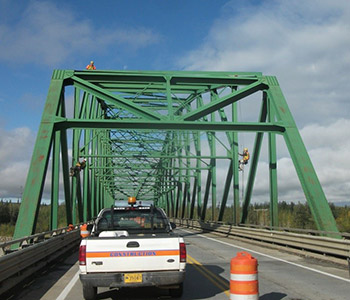
Hurricane Bridge, Parks Highway. Photo by Donna Gardino, Alaska DOT&PF

What is functional classification?

What are the implications of a road's functional classification?

How does functional classification affect project funding?

What is the definition of a "public road"?

Is the ADOT&PF or local agency assigned functional classification used as the basis  for determining design standards?

Has ADOT&PF been using supplemental state functional classification guidelines in  addition to FHWA's Functional Classification Manual?

What are the specific functional classifications and how do they differ for rural vs. urban areas?

What are Federal-Aid Urban Areas (i.e., Urbanized and Small Urban Areas)?

Where are Alaska's Federal-Aid Urban Areas (i.e., Urbanized and Small Urban Areas)?

Question What is functional classification?
Answer Functional classification is the "process by which streets and highways are grouped into classes, or systems, according to the character of service they are intended to provide."  In basic terms, a road can be functionally classified as:
  • Arterial: These roads provide mobility so traffic can move from one place to another quickly and safely./li>
  • Collector: These roads link arterials and local roads and perform some duties of each.
  • Local: These roads provide access to homes, businesses, and other property.
   
Question What are the implications of a road’s functional classification?
Answer Circumstances in which a road's functional classification is taken into account include:

  • Roadway Design, Construction, and Level of Maintenance
  • Access Management
  • Project Ranking, Scoring, and Funding; for detailed information about the Statewide Transportation Improvement Program (STIP) and funding, please visit ADOT&PF's STIP website at: http://www.dot.state.ak.us/stwdplng/cip/stip/index.shtml Leaving Functional Classification site
  • Emergency Relief Funding Sources
  • Modeling Air Quality Conformity
  • Highway Performance Monitoring System (HPMS) Reporting
  • Bridge Statistical Reporting
  • Federal Management Information System Reporting

Top of page

   
Question How does functional classification affect project funding?
Answer In Alaska, Federal Highway Administration (FHWA) funds can be used on any public roadway (regardless of the road's functional classification).  Road ownership and the state assigned federal functional classification determine which roadways are eligible for the following programs:
  • FHWA's Emergency Relief Program
  • FHWA's Emergency Relief for Federally Owned Roads (ERFO) Program
  • Federal Emergency Management Agency (FEMA) Assistance

The state assigned federal functional classification is one of many factors that are considered when evaluating projects for Statewide Transportation Improvement Program (STIP) funding.  A road's functional classification also affects the amount of local match a community may be responsible for when a project is being funded under the STIP.  For more information about the STIP and funding, please visit ADOT&PF's STIP website at: http://www.dot.state.ak.us/stwdplng/cip/stip/index.shtml Leaving Functional Classification site

Note: The functional classification evaluation process does not consider project funding needs as a basis for determining a road's classification.

   
Question What is the definition of a "public road"?
Answer A "public road" is any road under the jurisdiction of and maintained by a public authority and "open to public travel." This could range from a logging road to a multi-lane freeway. "Open to public travel" means that the road is available, except during scheduled periods (including seasonal closures), extreme weather, or emergency conditions; passable by standard passenger cars; and open to the general public for use without restrictive gates, prohibitive signs, or regulation other than restrictions based on size, weight, or class of registration.
   
Question Is the ADOT&PF or local agency assigned functional classification used as the basis for determining design standards?
Answer For all federally-funded projects, the ADOT&PF assigned functional classification is used as the basis for determining design standards. 
   
Question Has ADOT&PF been using supplemental state functional classification guidelines in addition to FHWA's Functional Classification Guidelines manual? Leaving Functional Classification site
Answer Yes, the following ADOT&PF supplemental guidelines were approved during the 1992-93 statewide functional classification update:
  • Airport access roads in isolated rural communities with Community Class airports will be classified as Major Collectors.  A Community Class airport provides the primary land or water access point to a rural community of at least 25 permanent year-round residents, without other reliable year-round access.
  • Access roads to rural communities of at least 25 permanent year-round residents, connected by land or marine routes, will be classified as Major Collectors.

(Note: A community includes any city, village, or census designated place as defined by the Census Bureau.)


Top of page


Question What are the specific functional classifications and how do they differ for rural vs. urban areas?
Answer

The same basic functional systems apply in both rural and urban areas. The specific functional classifications and the classification process are somewhat different for rural vs. urban areas due to the differences in land use, travel patterns, traffic volume, and road density. 

For both rural and urban areas, the basic functional systems are:  Arterial, Collector, and Local.   The Arterial and Collector functional systems are further stratified as follows:

Functional Classifications
Rural Areas Federal-Aid Urban Areas
(Urbanized & Small Urban)
Interstate Interstate
------------------------ Other Freeways & Expressways
Other Princpal Arterial Other Princpal Arterial
Minor Arterial Minor Arterial
Major Collector Collector
Minor Collector ------------------------
Local Road Local Street

For more detailed information, refer to FHWA’s Functional Classification Guidelines manual.

   
Question What are Federal-Aid Urban Areas (i.e., Urbanized and Small Urban Areas)?
Answer

The Census Bureau and FHWA have slightly different definitions for the term Urban Area. The Census Bureau uses the term Urban Area to refer to the Urbanized Areas and Urban Clusters designated by the Census Bureau.  FHWA uses the term Federal-Aid Urban Area to refer to the "adjusted" or "smoothed" Urbanized Areas and Small Urban Areas that are used for transportation planning purposes.  Federal-Aid Urban Areas are based on the Census designated Urban Areas.  FHWA allows the responsible state and local officials, in cooperation with each other and subject to approval by the Secretary, to "adjust" or "smooth" the Census designated Urban Area boundaries outward to delineate the Federal-Aid Urban Area boundaries.  FHWA requires state transportation departments to update their Federal-Aid Urban Areas based on the Census Bureau's decennial census data.

The "adjusting" or "smoothing" of Urbanized and Small Urban Area boundaries is a way of expanding Census defined boundaries to better reflect local conditions.  Boundaries are adjusted to smooth out irregularities; maintain administrative continuity of peripheral routes; and encompass fringe areas having residential, commercial, industrial, and/or national defense significance. 

For transportation planning purposes, Federal-Aid Urban Areas (i.e., Urbanized and Small Urban Areas) and Rural Areas are defined as follows:

Urbanized Area:
An area with a population of 50,000 or more designated by the Census Bureau, within boundaries to be fixed (i.e., adjusted or smoothed) by responsible state and local officials in cooperation with each other and subject to approval by the Secretary.  Such boundaries shall encompass, at a minimum, the entire Urbanized Area within a state as designated by the Census Bureau.

Small Urban Area:
In Alaska, a Small Urban Area is a Census Urban Cluster* with a population between 5,000 and 49,999 designated by the Census Bureau, within boundaries to be fixed (i.e., adjusted or smoothed) by responsible state and local officials in cooperation with each other and subject to approval by the Secretary. Such boundaries shall encompass, at a minimum, the entire Urban Cluster as designated by the Census Bureau. Small Urban Areas are located outside the boundaries of any Urbanized Area.

(*Note: A Census Urban Cluster consists of a central core and adjacent densely settled territory that together have a population between 2,500 and 49,999, generally with an overall population density of at least 1,000 people per square mile.)

Rural Area: 
Areas outside any Small Urban Area or Urbanized area.

Top of page


Question Where are Alaska's Federal-Aid Urban Areas (i.e., Urbanized and Small Urban Areas)?
Answer

Based on the Census Bureau's 2000 census data, Alaska's Federal-Aid Urban Areas (i.e., Urbanized and Small Urban Areas) are as follows:

Urbanized Areas:
Anchorage/Eagle River
Fairbanks/North Pole *

Small Urban Areas:
Juneau
Ketchikan
Kodiak
Moose Creek (Eielson AFB) *
Sitka
Wasilla*

*New Federal-Aid Urban Area based on the Census Bureau’s 2000 census data

Alaska Federal-Aid Urban Area Maps


If you have questions regarding the content of this page, please contact:
Jill Sullivan 
phone(907) 465-8592 or
email button jill.sullivan@alaska.gov